
Story
Discover how Forest Primeval was inspired to protect the virgin cloud forests of Mesoamerica
Story
The miracle of the montane cloud forests of Quiché Department Guatemala is that despite the onslaught of humankind, some magnificent examples still survive in their original pristine state—virgin, green, and filled with biodiversity.
Over the last 17 years, we protected nearly 40,000 acres of ancient forest at Cerro Amay, and now we are implementing our plan to reinvent sustainability planning to protect an additional 100,000 acres across the mountains of Quiché Department. This program is The Jewels of Quiché–Las Joyas de Quiché.
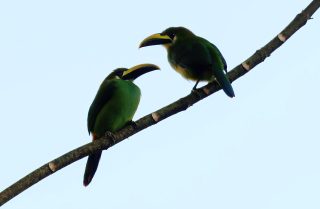
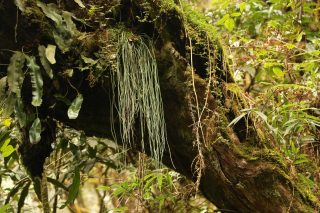
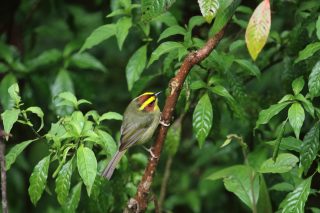
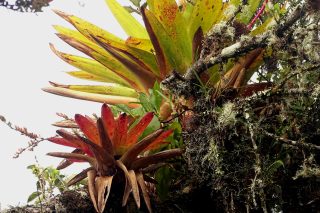
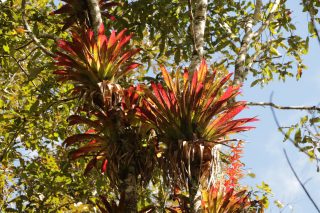
A major region of biological endemism, these mountains are remote and little-explored by biologists. These are indigenous lands where we venture with local Mayan guides from the Ixil, K’iché, and Poqomchí cultures.
Now we have the opportunity to make a deep and lasting change to this region by implementing Las Joyas de Quiché, which is not a conservation project so much as a sustainability movement that establishes the foundation for long-term conservation planning with the explicit support of indigenous municipal governments.
At its core, five forested mountaintop reserves and Guatemala’s most pristine river corridor, all now threatened with destruction, will be preserved to establish the most important montane conservation system in northern Central America.
Having worked in Quiché since 2008, we understand its political sensitivities. We know that to be effective our work must benefit the local people and respect their indigenous rights. We build consensus with the indigenous leadership in lockstep with ecosystem conservation that is bolstered by creative approaches to economic diversification that prevents the cutting of cloud forest and builds climate resilience through forest retention.
If you share our vision, please make a tax-deductible donation in any amount you are comfortable with, and we will apply it to ground-based operations that protect biodiversity and ecological services while promoting indigenous autonomy and governance. Your support will make this program a success.
Thank you,
Philip D. Tanimoto, Ph.D.
Executive Director

Team
Dr. Philip
Tanimoto
Tanimoto

Growing up in New England, Philip spent a lot of time exploring rivers and lakes from a canoe and observing birds through his binoculars. With degrees in natural sciences, he is focused on preserving Earth’s biota and improving our stewardship of wildlife, aquatic resources, natural landscapes, and ecological services.
In 1997, he established a nonprofit organization called Conservation Imaging (now Forest Primeval) which worked closely with other nonprofits, academic institutions, tribal entities, and municipalities to respond to threats and facilitate land use planning. An expert in spatial habitat modeling and forest analysis, his datasets have been used to advise management plans and conservation actions on three continents.
During his research, Philip discovered the little-known cloud forest of Cerro Amay, Guatemala, and since 2008, he has worked to preserve this remarkable forest ever since. That work laid the ‘foundations of trust’ among the local Mayan villagers that allowed our conservation efforts to proceed, starting with agroforestry, ecotourism, and biological research. Today he is spearheading ‘The Jewels of Quiché, to protect a stunning set of montane cloud forests where endemic fauna and flora thrive and irreplaceable ecosystem services survive.
Claudia Quijivix Hernández

Ms. Quijivix is a Guatemalan plant ecologist who speaks Spanish, English, Italian, German, and French. After obtaining her bachelor’s in biology, she is now focused on her master’s program in applied statistics. An expert tree climber, she uses the latest apparatus to access the high canopies of Guatemalan forests to conduct her research on the plants and animals living high above the forest floor. She was one of the first to ascend into the canopy at Cerro Amay, demonstrating that forest conservation is not for the faint of heart.
Claudia’s day job is in international emergency response through Poland-based Fundacja. She has worked on assignments in India, Ethiopia, Haiti, Chile, Colombia, Poland, California (wildfire response), and Ukraine. As a certified EMT, Claudia’s skills are invaluable wherever she works.
Professor Enrique Cor Silvestre

Mr. Cor has an unbridled passion for Guatemala’s natural beauty and is committed to both the conservation of, and education about, its soils, waters and forests. Enrique grew up in the Sacapultec Mayan culture in Quiché Department, and from his hometown of Sacapulas, he has an expansive view of the mountains of Las Joyas!
As Professor of Agronomy and Agriculture at the National University of San Carlos at Quiché, Professor Cor works with students from several Mayan cultures—the Ki’ché, Keq’chí, Ixil, and Sacapulteco among them. A born leader, he helps all his students understand that a career in agriculture is part of a 9,000 year old Guatemalan tradition that depends simultaneously on a love for the land, a love for nature, and constant adaptation. Enrique represents the Sacapultec community in the multi-ethnic COMUDE, an official planning committee of the Government of Quiché. He also donates his time generously to outdoor interpretation and education.
Erick Lopez

Erick is a Guatemalan herpetologist and president of the country’s leading mammal conservation association. As a biodiversity expert, he has built his expertise through extensive biological surveys across Guatemala, including Cerro Amay and Las Joyas. He is affiliated with multiple academic, conservation, and humanitarian organizations, and serves as a consultant on various projects aimed at preserving forests and wildlife while assessing the impacts of unchecked agricultural expansion on natural ecosystems.
Erick is also a climate and carbon researcher who collaborates with indigenous communities to develop resilience strategies against rising temperatures and shifting rainfall patterns. A strong advocate for forest regeneration, he applies innovative techniques to mitigate greenhouse gas emissions and addresses their connection to coffee production and other local crops.
Dr. Alejandra Zamora

Dr. Zamora is an Assistant Professor of Conservation Genetics at Universidad del Valle de Guatemala, and Director of the Center for Biotechnology Studies. In 2012, she was the first herpetologist to visit the nuclear cloud forest at Cerro Amay. There, she documented the occurrence of the endangered Plectrohyla guatemalensis—the Guatemalan spike-thumb frog, which occurs only in cloud forests that are themselves in peril.
Dr. Zamora is an expert in molecular genetics of the invasive Chytrid fungus that is decimating amphibian species in Latin America. She discovered Chytrid at Cerro Amay at low levels, which is probably low due to the pristine nature of the cloud forest there. As humans fragment the original forests using chainsaws, they spread this fungus ever deeper into the forest.
Dr. Igor Sarmientos

Dr. Sarmientos earned his M.D. with a specialization in pediatrics at the University of San Carlos, Guatemala. He conducted his research and fulfilled his residencies in the Guatemalan healthcare system. Since 2021, he has been affiliated with University Hospital in Magdenburg, Germany. Igor is Guatemala’s most skilled and prolific herpetofauna photographer and he photographed at Cerro Amay in 2025.
Louis Wray

Captain Louis, our Communications Director is an expert with digital media and Web development. Growing up on a fishing wharf in the Caribbean, he has spent nearly as many of his days at sea as he has on land. Passionate about protecting what remains of Earth’s magnificent biosphere, Louis has been contributing to conservation efforts throughout the Caribbean and Central America for over a decade. He has aided research and logistics in Belize, The Bahamas, Guatemala and the US and has taken the lead in developing our Website. His can-do attitude reflects his concern for protecting biodiversity.
Dr. Philip
Tanimoto
Tanimoto
Growing up in New England, Philip spent a lot of time exploring rivers and lakes from a canoe and observing birds through his binoculars. With degrees in natural sciences, he is focused on preserving Earth’s biota and improving our stewardship of wildlife, aquatic resources, natural landscapes, and ecological services.
In 1997, he established a nonprofit organization called Conservation Imaging (now Forest Primeval) which worked closely with other nonprofits, academic institutions, tribal entities, and municipalities to respond to threats and facilitate land use planning. An expert in spatial habitat modeling and forest analysis, his datasets have been used to advise management plans and conservation actions on three continents.
During his research, Philip discovered the little-known cloud forest of Cerro Amay, Guatemala, and since 2008, he has worked to preserve this remarkable forest ever since. That work laid the ‘foundations of trust’ among the local Mayan villagers that allowed our conservation efforts to proceed, starting with agroforestry, ecotourism, and biological research. Today he is spearheading ‘The Jewels of Quiché, to protect a stunning set of montane cloud forests where endemic fauna and flora thrive and irreplaceable ecosystem services survive.
Claudia Quijivix Hernández
Ms. Quijivix is a Guatemalan plant ecologist who speaks Spanish, English, Italian, German, and French. After obtaining her bachelor’s in biology, she is now focused on her master’s program in applied statistics. An expert tree climber, she uses the latest apparatus to access the high canopies of Guatemalan forests to conduct her research on the plants and animals living high above the forest floor. She was one of the first to ascend into the canopy at Cerro Amay, demonstrating that forest conservation is not for the faint of heart.
Claudia’s day job is in international emergency response through Poland-based Fundacja. She has worked on assignments in India, Ethiopia, Haiti, Chile, Colombia, Poland, California (wildfire response), and Ukraine. As a certified EMT, Claudia’s skills are invaluable wherever she works.
Professor Enrique Cor Silvestre
Mr. Cor has an unbridled passion for Guatemala’s natural beauty and is committed to both the conservation of, and education about, its soils, waters and forests. Enrique grew up in the Sacapultec Mayan culture in Quiché Department, and from his hometown of Sacapulas, he has an expansive view of the mountains of Las Joyas!
As Professor of Agronomy and Agriculture at the National University of San Carlos at Quiché, Professor Cor works with students from several Mayan cultures—the Ki’ché, Keq’chí, Ixil, and Sacapulteco among them. A born leader, he helps all his students understand that a career in agriculture is part of a 9,000 year old Guatemalan tradition that depends simultaneously on a love for the land, a love for nature, and constant adaptation. Enrique represents the Sacapultec community in the multi-ethnic COMUDE, an official planning committee of the Government of Quiché. He also donates his time generously to outdoor interpretation and education.
Erick Lopez
Erick is a Guatemalan herpetologist and president of the country’s leading mammal conservation association. As a biodiversity expert, he has built his expertise through extensive biological surveys across Guatemala, including Cerro Amay and Las Joyas. He is affiliated with multiple academic, conservation, and humanitarian organizations, and serves as a consultant on various projects aimed at preserving forests and wildlife while assessing the impacts of unchecked agricultural expansion on natural ecosystems.
Erick is also a climate and carbon researcher who collaborates with indigenous communities to develop resilience strategies against rising temperatures and shifting rainfall patterns. A strong advocate for forest regeneration, he applies innovative techniques to mitigate greenhouse gas emissions and addresses their connection to coffee production and other local crops.
Dr. Alejandra Zamora
Dr. Zamora is an Assistant Professor of Conservation Genetics at Universidad del Valle de Guatemala, and Director of the Center for Biotechnology Studies. In 2012, she was the first herpetologist to visit the nuclear cloud forest at Cerro Amay. There, she documented the occurrence of the endangered Plectrohyla guatemalensis—the Guatemalan spike-thumb frog, which occurs only in cloud forests that are themselves in peril.
Dr. Zamora is an expert in molecular genetics of the invasive Chytrid fungus that is decimating amphibian species in Latin America. She discovered Chytrid at Cerro Amay at low levels, which is probably low due to the pristine nature of the cloud forest there. As humans fragment the original forests using chainsaws, they spread this fungus ever deeper into the forest.
Dr. Igor Sarmientos
Dr. Sarmientos earned his M.D. with a specialization in pediatrics at the University of San Carlos, Guatemala. He conducted his research and fulfilled his residencies in the Guatemalan healthcare system. Since 2021, he has been affiliated with University Hospital in Magdenburg, Germany. Igor is Guatemala’s most skilled and prolific herpetofauna photographer and he photographed at Cerro Amay in 2025.
Louis Wray
Captain Louis, our Communications Director is an expert with digital media and Web development. Growing up on a fishing wharf in the Caribbean, he has spent nearly as many of his days at sea as he has on land. Passionate about protecting what remains of Earth’s magnificent biosphere, Louis has been contributing to conservation efforts throughout the Caribbean and Central America for over a decade. He has aided research and logistics in Belize, The Bahamas, Guatemala and the US and has taken the lead in developing our Website. His can-do attitude reflects his concern for protecting biodiversity.
